
The telecom regulator on Friday released a list of 40 "defaulter" principal entities, including large banks like HDFC Bank, SBI and ICICI Bank, that are not fulfilling the regulatory norms on bulk commercial messages despite repeated reminders. Hardening its stance on the issue, the Telecom Regulatory Authority of India (TRAI) warned that defaulting entities should comply with the stipulated requirements by March 31, 2021 "to avoid any disruption in the communication with customers" from April 1, 2021. "As sufficient opportunity has been given to principal entities/ telemarketers to comply with the regulatory requirements and that the consumers cannot be deprived of the benefits of the regulatory provisions any further, therefore it has been decided that from April 1, 2021, any message failing in the scrubbing process due to non-compliance of regulatory requirements will be rejected" by the system, TRAI said in a statement.

Cheil India has a strong presence in the retail and shopper marketing space.

Telecom gear makers, who are in talks with telcos, say that if all goes well, they are ready to roll out the first phase of 5G services from October this year and cover the country's top 30-50 cities (in limited areas) by March 2023. The gear makers expect the telecom companies to give them a heads-up about their plans as well as the equipment required by July, and have promised deployment in three to four months after that. India's main telecom gear suppliers are Nokia, Ericsson and Samsung.

Similar discounts compared to online led to a spike in demand for offline, where customers can get a more personal and hands-on product experience.

Indian plants -- who plan to begin production with 28 nano metre chips -- will take two to four years to get off the ground. By that time, in the fast changing world of chip making, the global market would have shifted to 22 nm.

iPhone, which accounts for just 3% of sales in India's 100 million-plus annual smartphone market, plans to partner an existing player

The content discovery platform designed to help you discover content and services in the language of your choice recently turned profitable. It has delivered 1 billion application installs and updates in the past 12 months, says Samreen Ahmad.

Which sectors will bounce back fast? Which will lag? Has the consumer changed forever? Here are some answers.

One needs to charge the device every four days, which can provide over 65,000 blood readings and counts.

The government is likely to extend fiscal incentives for production of toys, bicycles and leather and footwear in the forthcoming budget as it looks to expand production linked incentive (PLI) scheme to cover more high-employment potential sectors, sources said. The government has already rolled out the scheme with an outlay of about Rs 2 lakh crore for as many as 14 sectors, including automobiles and auto components, white goods, pharma, textiles, food products, high efficiency solar PV modules, advance chemistry cell and speciality steel. The scheme aims to make domestic manufacturing globally competitive and create global champions in manufacturing, and it is yielding solid results, sources said.

Reliance Jio may not ask for a premium for its 5G services in the initial stages of the launch, according to sources in the company. The company will roll out 5G commercial services in four cities -Delhi, Mumbai, Chennai, and Kolkata - around Diwali this month and slowly ramp up the processes for other cities, too. A senior executive, when asked whether Jio will charge higher tariffs for 5G against 4G, said: "In the initial stages, customers have to adopt 5G, then they will have to find value in the service, and then one can look at monetisation."

Though leading brands like Samsung, Apple, Xiaomi, OnePlus, and Oppo managed to absorb the initial lockdown shock and resumed their local production back to 60 per cent, they would likely suffer a 20-25 per cent loss of sales in the October-December quarter.

From spreading updates about the brand and upcoming devices to creating personalised world-of-mouth goodwill for Xiaomi -- its online army of fans have swelled parallelly with Xiaomi's fortunes in the country.

As many as 80 brands are riding the digital and television broadcast this year.

The wait for the new iPhone is over as the tech giant Apple officially launched its new iPhone 13 and iPhone 13 Pro on September 14.

The apex court has settled the long-pending dispute between companies such as Samsung, IBM, HP & others and the tax department.

The five-year-old Chinese brand's assent to the summit comes after a year of astounding rise -- often growing by over 200 percent a quarter, reports Arnab Dutta.

Samsung Galaxy i899 will offer an enhanced experience of seamless speed data on the move, offering speeds of up to 3.1 Mbps to Reliance Mobile customers.

Telecom operator Bharti Airtel will start rolling out 5G services later this month as it signed requisite agreements with Ericsson, Nokia and Samsung. At the recently held much-awaited spectrum auction for 5G services by the Department of Telecom, Airtel bid for and acquired 19867.8 MHZ spectrum in 900 MHz, 1800 MHz, 2100 MHz, 3300 MHz, and 26 GHz frequencies. "We are delighted to announce that Airtel will commence roll out of 5G services in August.

Apple Inc is commencing assembly of its iPhone 12 model in the country, a move that is expected to help the US tech giant further consolidate its position in the burgeoning smartphone market in India. Apple has partnered with third-party manufacturers like Foxconn and Wistron to make some of its phones in India. These include iPhone SE, iPhone 10R and iPhone 11.

Industry estimates suggest that the extent of value addition in the handset space remains at a mere 10 per cent. That effectively means, value-wise 90 per cent of all components used in making a handset continues to be imported.

Known for its phones and emerging from nowhere in the segment, it might take on the scooter Goliaths.

The US tech major is planning to begin local production of its upcoming iPhone 12 by next April - within six months of its launch.
While the government has not barred procurement of equipment from Chinese companies, the process to amend the general financial rules (GFR) 2017 has started. This will impose restrictions on bidders in public procurement from countries that share a land border with India, reports Megha Manchanda.

Amazon has reclaimed the top spot as the world's most valuable brand despite its brand value falling 15 per cent this year from $350.3 billion to $299.3 billion, said a new report. According to brand valuation consultancy Brand Finance's report, "Global 500 2023", while Amazon is back at No 1, its brand value has fallen by over $50 billion this year, with its rating slipping from AAA+ to AAA. This is as consumers evaluate it more harshly in the post-pandemic world. Brand Finance's research has found that perception of customer service at Amazon has fallen - at the same time as delivery times have lengthened.

Like last year, this year too smartphones dominated the most successful launches taking the top three slots, with two auto brands completing the top 5 line-up.
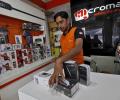
At least two of them - Lava and Micromax - are arming themselves against the Chinese rivals which made them insignificant in the local market over the past few years.

As part of its expansion plans, Jio has announced the roll-out of Internet of Things (IoT) services in association with Samsung, which will help consumers and enterprises.

Top companies across sectors -- automobile maker Maruti Suzuki, consumer electronics giant Samsung to IT giant Infosys -- have reopened factories and offices as India took its first steps towards resuming economic activity after weeks under a near-total coronavirus lockdown.

A few days ago, Reliance Retail surprised the market by acquiring the Campa brand from Delhi-based Pure Drinks Ltd for Rs 22 crore. A successful cola brand in the eighties, especially in North India, Campa Cola thrived when Coke exited India in the late seventies. When the Atlanta-based major returned and PepsiCo set base in India, it went down fighting.

Apple was a fringe player in all key categories like smartphones, notebooks, and tablets till recently. But with the last quarter's record-breaking performance, the brand has established itself in the country's price-sensitive consumer electronics market.

Apart from bringing new suppliers on board, Xiaomi is also hoping to take advantage of the newly launched PLI scheme that offers incentives on incremental production of smartphones with 2020 as the base year.

The government will undertake a detailed evaluation of applications it has received in response to the mega semiconductor scheme and expects to complete the entire process and sign agreements with companies in next 8-10 months, according to Union Minister for Electronics and IT Ashwini Vaishnaw. Vaishnaw said he is happy with the response that came in within a short period of time, when the ministry invited applications under the Rs 76,000 crore semiconductor programme. The government is confident of seeing one of the big global players in semiconductor industry coming in the next round, Vaishnaw told PTI in an interview. He asserted that many other players too are "seriously evaluating" India's semiconductor programme, and that the ministry is in discussions with several companies.

Policies to break down the business group format are far more likely to be effective, argues Simon Commander.

Work is underway in identifying global companies in sectors ranging from electronics, auto components and medical equipment to shift part of their existing or incremental manufacturing to India.

Given the security dilemma prevailing between India and China, India should curb the operation of Chinese telecom companies in India, asserts Dr Rup Narayan Das.

The US-based company, in collaboration with partners like Wistron and Foxconn, had recently started assembling iPhone 11 in India.

iPad 2 will make its entry into India on April 29, just a month after the older version was launched here.

The launch of premium devices from OnePlus and Samsung in the second half of Apple's reporting period added to Apple's woes.

With 8.5 per cent market share in the quarter ended September 2017, Nokia makes it to the top four bestselling feature phones in India.
